Federal review of Surprise ICE center would keep detainees inside if chemical warehouse next door leaks
DHS's draft environmental assessment gives one bullet point to the risk from Rinchem. No emergency plan exists yet, evacuation is left to local responders the city says lack the capacity, and the only fire response time in the review is from another city.
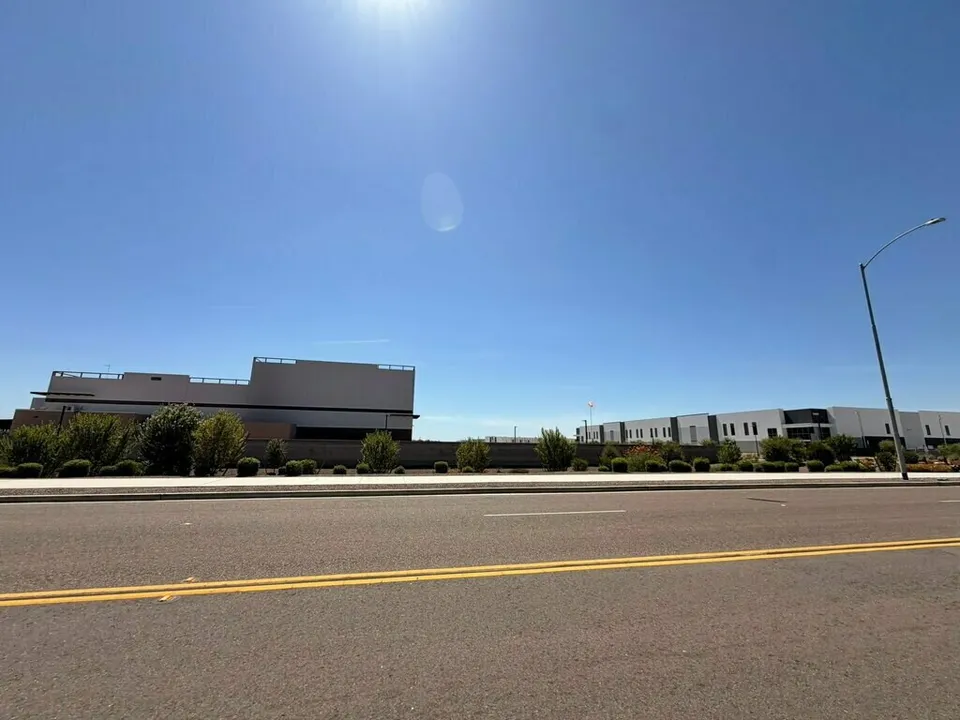
Looking south across West Sweetwater Avenue from the warehouse ICE plans to convert into a detention center. Rinchem's chemical warehouse and a vacant warehouse sit on that side of the street. Photographed in September for the site assessment attached to DHS's draft environmental review. Photo: Partner Engineering and Science, via U.S. Department of Homeland Security.
This story was drafted with AI from public records and reviewed by an editor before publication. How we use AI
If a chemical leak at the warehouse across the street ever forces a choice, the federal plan for Surprise's proposed immigration detention center is to keep the people inside.
The Department of Homeland Security released a draft environmental assessment for the 1,500-bed center at 13290 W. Sweetwater Ave. on Nov. 9. Across the draft and its appendices, the risk from Rinchem, a warehouse that stores hazardous chemicals for the semiconductor industry, gets one bullet point:
"Develop and maintain an Emergency Response Plan to address potential off-site accidental chemical releases. It is anticipated that the facility would establish a shelter-in-place protocol due to the presence of a closed-loop HVAC system. Any secure evacuation of detainees would be coordinated with local emergency response providers and ICE."
That plan does not exist yet. The assessment says it will be developed. On Oct. 20, Surprise officials told the City Council they had asked DHS for an emergency plan for the site and had not received one.
The draft concludes the center would cause no significant environmental harm as long as it meets the city's water requirements. The public has 30 days from Nov. 9 to comment.
What the review says about Rinchem
Rinchem's warehouse at 13255 W. Sweetwater Ave. sits on the south side of the street. The assessment names it once. It notes that Rinchem files a federal risk management plan, which the Clean Air Act requires of "facilities that use substances that pose the greatest risk of harm from accidental releases." It adds that no violations or releases have been reported there.
The assessment goes no further. It does not say what chemicals Rinchem stores, how much, or how far a release could spread. It does not draw on Rinchem's risk management plan, which models release scenarios, and it does not mention wind. A database report attached to the assessment lists Rinchem 0.02 miles, or about 92 feet, from the property.
The Rinchem passage comes from a Phase I environmental site assessment by Partner Engineering and Science, attached as an appendix. That kind of report checks whether a property's land is contaminated, mainly to protect a buyer from cleanup liability. It found none, and the draft relies on it to conclude that hazardous materials pose no significant risk.
The draft also does not say how much diesel fuel the center itself would store across the street from Rinchem. It plans twelve 500-kilowatt emergency generators and diesel-powered fire pumps. Its hazardous-materials section counts only an existing 555-gallon diesel tank and says no hazardous materials are routinely used at the site. A permit table in the draft's appendix says the total amount of fuel storage and the potential for a spill "remain unresolved."
The draft's section on human health and safety lists the emergencies the center could bring: medical calls, fires, traffic crashes and security incidents. A chemical release is not on the list. The draft's land-use section calls a detention center "compatible with surrounding industrial and commercial land uses."
Fire data from another city
The draft's only measure of how quickly firefighters could reach the site comes from a different city's fire department.
It cites an average response time of 6 minutes 21 seconds for the Maricopa Fire/Medical Department, attributing the figure to that department's 2025 annual report. Maricopa is a separate city in Pinal County, about 43 miles from Surprise in a straight line. The City of Maricopa news article the draft lists as its source does not contain the figure.
The draft says the figure "should be treated as a regional reference point rather than a confirmed Surprise-specific performance measure."
Surprise publishes its own response times. The city's online performance dashboard puts the citywide average at 5 minutes 54 seconds, measured from the first call to the first unit on scene. It also gives figures for each of the city's nine fire stations.
The closest is Station 308 at 13771 W. Cactus Road, about eight-tenths of a mile from the site. The dashboard lists Station 308's average response time as 5 minutes 41 seconds, with 90% of its calls reached within 6 minutes 51 seconds as of March 26, 2026.
The draft lists all nine stations by address but uses none of the city's figures, and it does not say which station is closest to the site.
A promise, not a condition
The off-site emergency plan is listed among the "project commitments," under a heading that says "no mitigation measures are warranted" for hazardous materials.
Free newsletter
Follow this story
Free, once a week: what happens next at Surprise City Hall, from council votes to what is being built near you.
Mitigation measures are what DHS would formally adopt as conditions of its final decision, in a document called a finding of no significant impact. The draft of that finding lists conditions only for water. Its section on hazardous materials covers fuels, cleaning products and spill handling, and does not mention Rinchem, a chemical release, sheltering in place or evacuation.
Who would get people out
The assessment leaves any evacuation of detainees to "local emergency response providers and ICE."
At the Oct. 20 work session, Surprise officials described the city's role differently. "We let people know where the evacuation is needed and when and how but everyone is responsible to self-evacuate," a city official told the council. "We do not have the resources or the capacity to evacuate surrounding facilities." A fire official said the department's role in a building evacuation is to "advise and assist," and that the plan belongs to the building's occupant.
The assessment does not describe the "closed-loop HVAC system" it relies on for sheltering in place, or say how long the building could stay sealed. The center would hold up to 1,500 detainees and about 676 staff across three shifts.
The draft names Sweetwater Avenue as the center's main way in and out, reached from Dysart Road. Sweetwater dead-ends at a rail line west of the site, the draft says, so traffic leaving the center heads east toward Dysart, along the street Rinchem faces. The draft does not discuss that route in connection with a chemical release.
Other claims that do not hold up
The review contains other statements that conflict with its own appendices or with public records.
Air permits. The draft says that in Arizona, emergency generators used only in emergencies and for maintenance "are not required to obtain air permits." The center would have twelve 500-kilowatt generators. The draft's own permit table lists a Maricopa County air permit for the generators and diesel fire pumps as "To be determined" and says eligibility for a general permit "must not be assumed." The draft also calls the generators the center's only stationary source of air pollution, leaving out the fire pumps the permit table lists.
Police. The draft names the Maricopa County Sheriff's Office District 3, on Bell Road, as "the nearest law enforcement facility in Surprise." The site is inside city limits, where Surprise police respond. The Surprise Police Department's headquarters on Statler Plaza, which appears in the draft's own list of agencies, is closer: about 2.3 miles from the site, compared with about 2.6 miles for the sheriff's office.
County rules. The draft applies Maricopa County's noise ordinance, which by its own terms covers only unincorporated areas, and says county planners set zoning standards for the site. The site is inside Surprise, which sets its own zoning.
Construction time. The draft says the retrofit "would be expected to be completed within roughly 30 days," and uses that to conclude out-of-town construction workers would have little effect on housing. It gives no source. The work it describes includes an 800,000-gallon water tank, chilled-water plants, three transformers, the generators, new sewer systems, detainee housing units, a kitchen and a laundry.
Traffic. The draft concludes traffic effects would not be significant. It also says the city's traffic counts do not cover Dysart Road near Sweetwater and that "a formal peak-hour intersection analysis cannot be calculated from currently available information." It finds that the 3 p.m. shift change, when about 540 employees would be arriving or leaving, overlaps afternoon school traffic. Dysart High School is about nine-tenths of a mile from the site.
Who wrote it
Three DHS and ICE environmental specialists reviewed the draft. Consultants under contract to GardaWorld Federal Services, the company DHS hired to convert and run the center, prepared it, the draft says. It relies on a hazardous materials management plan written by GardaWorld that it says "outlines emergency-response protocols." That plan is not among the published documents.
What comes next
ICE will review comments and issue a final assessment. Under a court agreement that paused Arizona Attorney General Kris Mayes's lawsuit, DHS cannot convert the building until the review is final. After that, the state has 10 days to decide whether to ask the court again to block the project, KTAR reported. Mayes's lawsuit had argued that Rinchem's risk management plan does not account for a detention center across the street.
Free newsletter
Follow this story
Free, once a week: what happens next at Surprise City Hall, from council votes to what is being built near you.