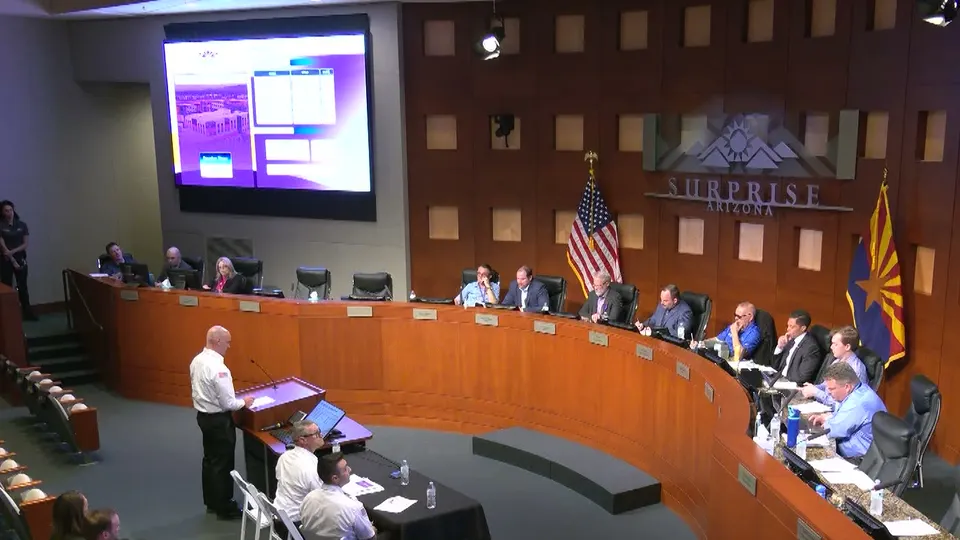
Eight months after Surprise asked the federal government how much help its firefighters and police would need to give an immigration detention center, the city still has no emergency plan for the site, city officials told the City Council on Oct. 20.
"At this time we have not received any emergency plans or how they plan to handle the facility," City Manager Andrea Davis told Councilmember Patrick Duffy at a work session on hazardous-materials response.
The detention center is planned across the street from Rinchem, a warehouse that stores hazardous chemicals. The work session, which Duffy requested at the council's June 16 meeting, was the council's first public look at how the city would respond to an emergency there. Opponents of the detention center have raised Rinchem at council meetings since at least June. The council took no vote; the item was for discussion only.
Two buildings, one street
The Department of Homeland Security bought a 418,400-square-foot warehouse at 13290 W. Sweetwater Ave., near Dysart Road, in January for more than $70 million, The Arizona Republic reported. ICE confirmed it would hold about 1,500 people there. DHS awarded GardaWorld Federal Services a contract worth more than $313 million to convert and run it, according to federal spending records reported by Arizona's Family.
Rinchem opened its warehouse of more than 123,000 square feet in Surprise in early 2024 to store hazardous chemicals and gases for the semiconductor industry, according to the trade publication Bulk Transporter. Councilmember Chris Judd said at the work session that he believed Rinchem supplies Taiwan Semiconductor Manufacturing Co. exclusively.
The two buildings are roughly 300 to 400 feet apart, according to figures given during the discussion.
The detention center is on hold. Under an agreement Arizona Attorney General Kris Mayes reached with DHS in July, after suing in April, the agency cannot retrofit the building until it completes a federal environmental review. In a September court filing, DHS said the review "remains ongoing," KJZZ reported.
What the city has asked for
On Feb. 11 the council voted 5-1 to send DHS Secretary Kristi Noem and ICE Acting Director Todd Lyons a letter signed by Mayor Kevin Sartor. Councilmember Jack Hastings voted no, and Councilmember Nick Haney was absent, the minutes show.
The letter asked for written answers on the building's purpose, planned renovations, zoning, traffic and environmental review. It also asked "the expected level of coordination and support required from local law enforcement, fire, and emergency medical services." It noted that council members and staff would be in Washington from March 15 through March 19 and asked for a meeting.
On April 21, City Manager Andrea Davis told the council that the city touches base with DHS "once a week," and that some questions the city had sent remained unanswered. At the same meeting, Judd said the city attorney had found that cities "have zero luck going against zoning with the federal government."
The council wrote again on May 5, to Homeland Security Secretary Markwayne Mullin, asking that ICE comply with state law and local zoning, Cronkite News reported.
How the city would respond
At the Oct. 20 work session, fire officials told the council that Surprise Fire-Medical inspects hazardous-materials sites once a year, and that crews walk through such buildings separately to plan for emergencies there. What they learn goes into the dispatch system, so crews arrive knowing where chemicals are stored.
Assistant Chief Cody Worrell said facilities that store hazardous chemicals must file an annual "Tier 2" report through a state portal that reaches the state, the county and the fire department. In Arizona that report includes the facility's emergency response plan. Sites with certain extremely hazardous chemicals must also file a federal risk management plan, updated at least every five years, which models how far a release could spread.
Chief James Ruff described the response. The first crew approaches from "upwind, uphill, and upstream," isolates the area and calls for help. Hazmat technicians follow, and other Valley departments join through the regional automatic-aid system. "Tactics follow the chemistry," he said.
Depending on the chemical and the weather, commanders may order people to shelter in place or evacuate. The city would warn people through wireless emergency alerts to phones in the affected area, the city website and social media, and its Rave reverse-911 system, Worrell said.
Who gets people out
The city does not evacuate buildings itself, City Manager Andrea Davis told the council. "We let people know where the evacuation is needed and when and how but everyone is responsible to self-evacuate," Davis said. "We do not have the resources or the capacity to evacuate surrounding facilities."
Worrell said the fire department's role in a building evacuation is to "advise and assist." It is up to a building's occupant to have a plan, he said, and DHS has not shared one. Davis said the city had asked DHS for its emergency plan. "I don't know what they will share," she said.
Planning Manager Trevor Fleetham said the warehouse site plan met the setback requirements for land next to other industrial zoning. A residential use next to an industrial one would require larger setbacks, he said.
"What they're basically trying to do is put a hotel next to a chemical facility and that's something we wouldn't allow," Duffy said. "This is a safety issue."
Vice Mayor Earle Greenberg said Duffy "was being generous when he called it a hotel because if there were a hotel," people "could just get in their cars and leave."
Greenberg also raised the tanker trucks that park on the street near Rinchem, which he called "an attractive nuisance for a bad actor." City staff told the council on Aug. 4 that patrols near Rinchem had been increased and some drivers cited.
Mayor Sartor said he agreed with Duffy that the site "is not a good location for a 1500 person detention facility." But "it's a federal action and the federal action doesn't have to abide by any of our zoning by any of our ordinances," he said. He said city officials had gone to Washington, met federal officials in Surprise and talked to every federal elected official they could.
Judd asked about nearby schools. A fire official said the city has plans with the Dysart Unified School District to help it evacuate campuses. Rinchem has no rail spur to its site, an official said, so a truck carrying chemicals is among the scenarios crews train for.
Haney asked whether a building that withholds information from firefighters makes their job more dangerous. A fire official said it can. Any failure to share that information "is extremely concerning to me," Haney said.
What residents said
At the regular council meeting that followed, Brent Peek, who said he lives in north Phoenix, said he was "extremely disheartened to hear that there has been no communication from DHS or Garda World about emergency planning." ABC15 has identified Peek as a co-chair of Northwest Valley Indivisible, a group that opposes the facility.
Peek said one scenario in Rinchem's risk management plan models a release of hydrogen chloride that would spread toxic gas 2.7 miles and affect 73,000 people. Mayes's lawsuit argued that Rinchem's plan, filed Jan. 1, does not account for a detention center across the street.
Another speaker, Alex Crist, said it was disappointing that no federal representative came to answer questions.
Whats Next?
As of Oct. 20, eight months after the council's first letter, the city had received no emergency plan for the site. "As fast as they were trying to open, you think that'd be pretty important … we need some answers from them," Councilman Duffy said.