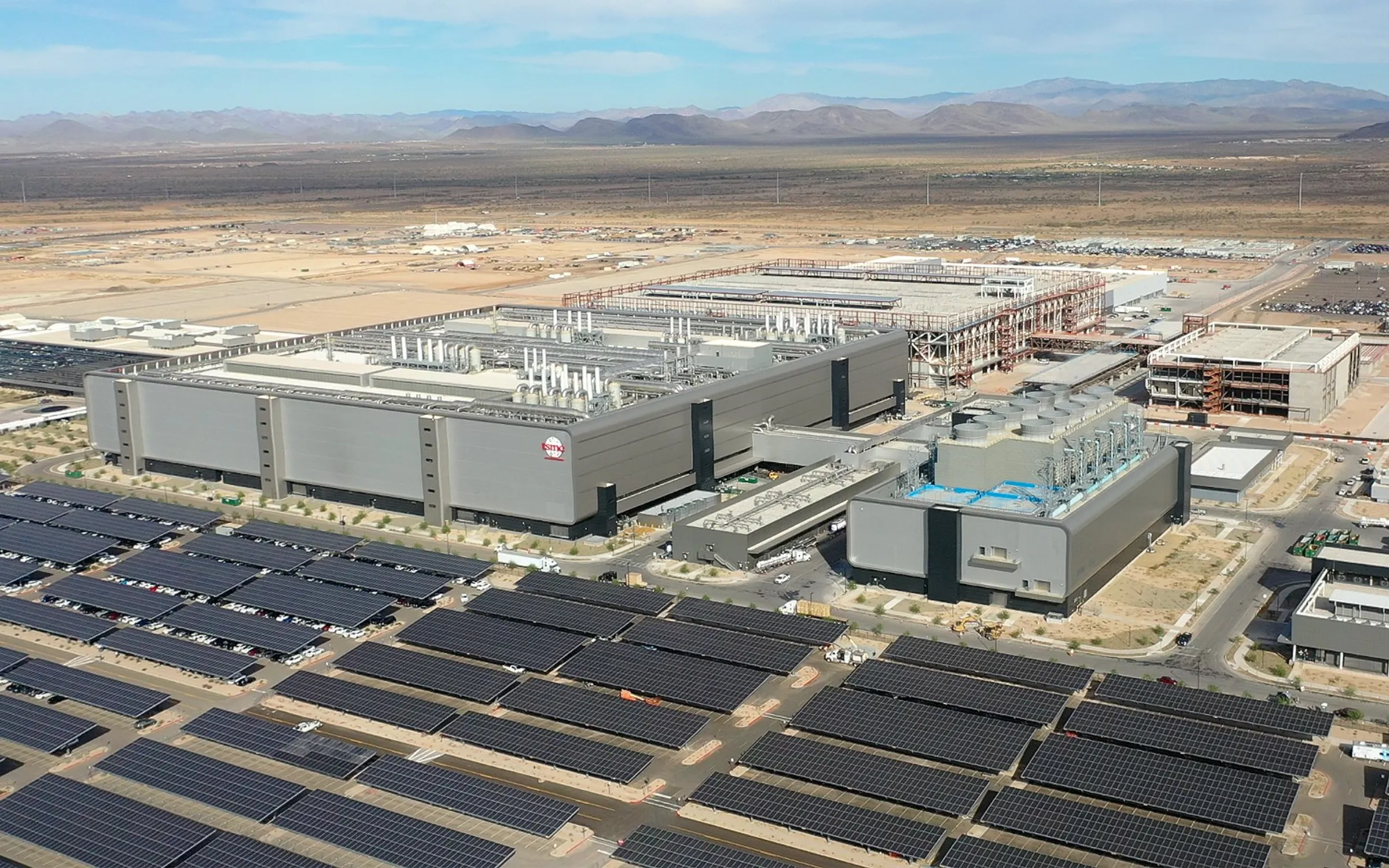
Taiwan Semiconductor Manufacturing Co. said in July it will spend another $100 billion in north Phoenix on four more chip factories, bringing its announced Arizona total to $265 billion.
The campus sits on Loop 303 in north Phoenix, about 25 miles from Surprise City Hall by road and 16 miles in a straight line. Surprise officials cite it often. What the public record shows it has brought the city so far is narrower: three supplier buildings, a recruiting effort aimed at Taiwan, and no estimate from anyone of what the chip industry is worth to Surprise.
What is here now
Rinchem. The New Mexico-based chemical logistics company opened a 123,516-square-foot hazardous-materials warehouse at 13255 W. Sweetwater Ave. in February 2024, on land bought in October 2021 for $4.2 million, according to county property records. Its announcement said the building would serve "a leading player in the semiconductor industry," which it did not name. Its website says the warehouse makes daily deliveries to nearby chip factories. The city's economic development staff lists Rinchem among employers the Greater Phoenix Economic Council helped bring to Surprise.
Uangyih. Uangyih-Tech Industrial Co., based in Taipei and registered in the U.S. as UYS-Tech Inc., paid $20.4 million for a 107,400-square-foot industrial building at 13280 W. Rioglass Solar Road, built in 2022. County property records date the sale to May and show the deed recorded July 16. The company began as a piping-materials agent and now describes itself as an engineering firm and a major supplier of air-abatement systems, which clean the exhaust from chip factories.
Directly Technology. Another Taiwan-based supplier bought a 48,445-square-foot building at 10701 N. Solar Canyon Way, in the Echo Park @ P132 business park, in June for $10.7 million, county records show. The building was finished in 2024. The company makes diffusion furnaces, heaters, thermocouples and quartz parts for chip factories and services them, and the building is its first U.S. site, Hoodline reported, crediting CoStar. The company has not said how many people it will employ there or what it will do in the building.
Two of the three Surprise buildings were bought this year.
No other chip-industry company in Surprise turned up in the city's meeting record, in news coverage or in a search of county property records for industrial sales since 2020. That search finds only owners under their own names, so a company leasing space would not show up.
What the city is doing
Surprise's economic development director, Jeanine Jerkovic, was at the SEMICON Taiwan trade show in early September, a colleague told the City Council on Sept. 1. More than 100 Arizona officials and business leaders made that trip, the state's third to Taiwan this year, KJZZ reported.
Mayor Kevin Sartor said Oct. 6 that Taiwanese businesses attended the opening of Spark Surprise, the city's new business resource hub, and that they belonged to a business incubator in Taiwan. He said Jerkovic's team was working with that group "to try to develop some sort of partnership so we can get some of those businesses here."
The city's budget lists "foreign direct investment" and "advanced manufacturing and rail-served industry" among the sectors it is recruiting. Surprise pays the Greater Phoenix Economic Council $84,690 this fiscal year to market the region. Jerkovic told the City Council in June that the organization's work had produced 584 jobs and more than $250 million in investment in Surprise over five years. She did not say how much of that, if any, is tied to semiconductors.
Around the Northwest Valley
TSMC's first Phoenix factory began volume production in the last three months of 2024, the company has said. Before then, The Standard could document three chip-industry sites in the Northwest Valley: Rinchem's warehouse, and leased space in Glendale for Kokusai Semiconductor Equipment, a Japanese equipment maker that set up spare-parts distribution, training and offices there, and for Taiwan Puritic, a Taiwanese supplier, both reported in 2022. Since production began, at least four more have bought buildings, opened or broken ground.
The nearest large project is not TSMC. Amkor Technology is building a chip packaging and testing campus in Peoria, at Loop 303 and Lake Pleasant Parkway. Amkor first announced the plant in November 2023 for a site in Vistancia, moved it to a 104-acre site in the Peoria Innovation Core in August 2025 and broke ground that October, at $7 billion. In September it raised the total to $12 billion, on a campus now about 170 acres, with a second phase to be built from late 2027 to the end of 2029. Production is to begin in 2028, and the two phases are expected to employ about 3,500 people. TSMC signed a 10-year agreement in June to buy packaging from Amkor.
In Glendale, Taiwan-based Gudeng Precision Industrial opened a $5 million, 12,000-square-foot plant Oct. 6 in the 51 Bells business park on Phelps Road, with more than 30 jobs, AZ Big Media reported.
Most of TSMC's suppliers are not out here. They cluster around the TSMC campus and the Deer Valley Airport in north Phoenix. One of them, Germany's DAS Environmental Experts, which treats exhaust gas and wastewater from chip factories, has a Glendale address, but it is at the city's northern tip near Interstate 17, a few miles south of TSMC. DAS opened an office in the area in 2022 and expanded it into an innovation and support center in October 2025, the company said.
This story has an interactive map. Open it on our website to explore it.
The Standard found no chip company that owned property in the Northwest Valley before TSMC announced its Arizona plans in 2020. That is the result of a records search, not proof that none did.
What could come
TSMC says it employs more than 3,500 people in Arizona. The state counts more than 70 semiconductor expansions since 2020.
Sartor named both companies on Oct. 6 when he asked a regional business group what other employers it wanted along Loop 303, saying the corridor has many warehouses, "but those don't have a lot of jobs."
That group, WESTMARC, is starting a workforce program along the 303. Its representative told the council that West Valley employers repeatedly name child care, housing and transportation as barriers to hiring and keeping workers, and that Amkor was the first company to join.
What stands in the way
Land. Asked by Councilmember Jack Hastings on June 16 whether Surprise has much industrial land, Lloyd Abrams, the assistant city manager and community development director, said there wasn't a lot, according to the meeting minutes. Industrial zoning is largely limited to the Railplex and the area around the landfill, the council was told.
Commuting. Nine in 10 employed Surprise residents left the city for work in 2019, according to census figures in a city fee study: 50,087 of 55,711.
Power. Planning and Zoning Commissioner Kevin Perry argued on Aug. 6 that Surprise cannot share in TSMC's growth, "20 to 25 miles down the road," without a stable electrical grid. The commission was weighing a zoning amendment that sets where large battery energy-storage facilities may go.
Safety. Since June, residents have told the council that Rinchem stores chlorine, fluorine and hydrogen chloride in quantities that require a federal risk plan, and that tanker trucks waiting to unload have parked at fire hydrants and in fire lanes on Sweetwater Avenue. Speakers said they noticed the warehouse because of a federal immigration detention center proposed for the same street. Asked by the mayor on Aug. 4, City Manager Andrea Davis said the city had increased patrols and monitoring and had cited some drivers. Rinchem's website now tells drivers waiting to unload to park on Summit Parkway, not on Sweetwater Avenue or in a fire lane.
The studies
The one economic study in public view covers the region and the state, not Surprise.
The Greater Phoenix Economic Council estimated in April 2024 that TSMC's first three factories, then a $65 billion plan, would generate $32.9 billion in economic output, $9.3 billion in personal income and $1.4 billion in state tax revenue over 13 years. TSMC publishes those figures. They have not been updated for the larger plan, and the full analysis is not posted.
Jerkovic, introducing the council's president, Christine Mackay, to the Surprise council in June, called her "the powerhouse behind the TSMC deal."
No study of TSMC's effect on Surprise, or on the West Valley by city, was found.