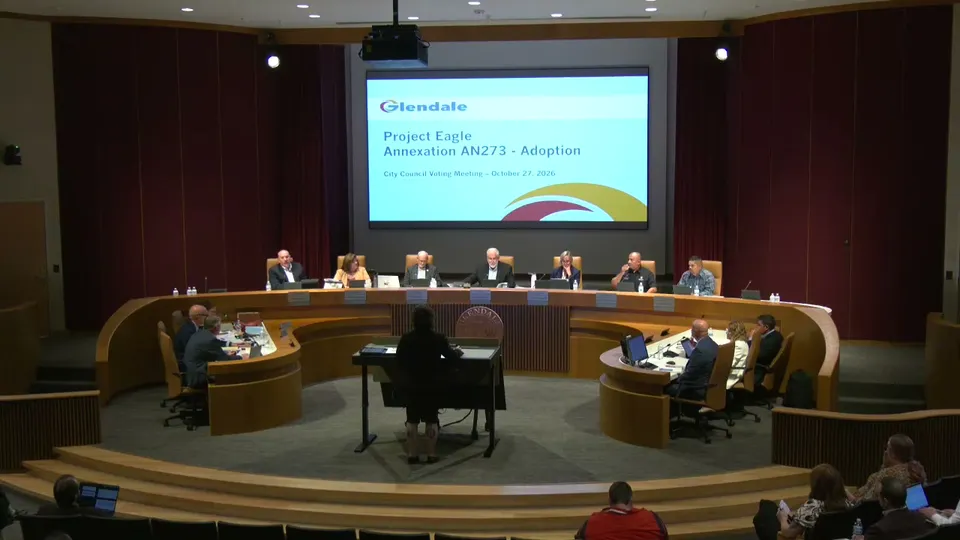
The Glendale City Council voted 6-1 on Oct. 27 to annex about 160 acres of farmland west of Litchfield Road and Olive Avenue. In a second vote it rezoned the land for a campus of three data centers, a natural gas power plant with 18 turbines, and an APS substation.
The site is in unincorporated Maricopa County, and the annexation brings it into Glendale. It lies just south of several Surprise neighborhoods. A project document in the council packet lists the Rancho Gabriela HOA park as about a mile away, and Marley Park among the neighborhood parks one to two miles away. Most of the residents who spoke against the project that night live in Surprise, in Waddell or in the unincorporated county. Glendale's council does not represent any of them.
Councilmember Leandro Baldenegro cast the only no vote on both ordinances. Mayor Jerry Weiers, Vice Mayor Ray Malnar and Councilmembers Lupe Conchas Jr., Dianna Guzman, Lauren Tolmachoff and Bart Turner voted for the annexation.
What is planned
The project has two parts, according to the applicant's attorney, Ed Bull of Burch & Cracchiolo. Project Eagle is the data center campus, and Project Baccara is the power plant beside it. Both are on land owned by Baccara Eagle Land LLC.
City staff described three one-story data centers totaling 1.1 million square feet. The turbine yard, in the southeast corner, would hold eighteen 72-foot-tall gas turbines that come online in phases as each data center is built. The APS substation, in the northeast corner, is the last phase and is expected to be finished in 2030.
The power plant would burn natural gas brought in by underground pipeline, with propane as backup fuel. Backup generators at the data centers would run on diesel. The Arizona Corporation Commission approved the plant's certificate of environmental compatibility 5-0 on Feb. 4. The commission described the plant as 700.2 megawatts.
Until the substation is built, power from the plant would run through Electric District No. 7 to the data centers, Bull told the council. After that, it would go into the APS grid.
The land is in the 75- and 80-decibel noise zones around Luke Air Force Base, where state law bars new homes. Luke's June 30 review letter found the uses compatible only if the developer meets its conditions, and the zoning requires the developer to meet them. The zoning carries 11 other stipulations, including continuous emissions monitoring under the county air permit.
The Surprise connection
The Planning Commission's staff report says a future northern entrance would extend the 143rd Avenue alignment to Peoria Avenue. The city of Surprise owns and maintains Peoria Avenue at that intersection and will approve that connection before it is built. It is currently unknown when and how that approval would come to the city, and whether the city has taken a position on the project.
Surprise residents have brought the project to their own City Council. At a November 2025 meeting, Roy Dunbar asked the council to oppose it, saying he spoke for an opposition group of more than 1,200 people. He named Rancho Gabriela, Greer Farms, Marley Park and Copper Canyon as the Surprise neighborhoods most affected. Residents spoke against it again during public comment in February and May, according to the council's minutes.
In his presentation Oct. 27, Bull told the Glendale council that the opposition he knew of came mostly from Surprise and county residents.
What residents said
Surprise residents also spoke at the council's first hearing on the annexation, Sept. 22. Melissa Parsons, who said she is a retired Air Force officer living about a mile from the site, said Luke's approval was conditional and asked what authority and risk Glendale would take on by annexing. No vote was taken that night.
On Oct. 27, Tom Bakem, who said he lives in Surprise's Rancho Gabriela neighborhood, told the council he did not oppose the data centers but did oppose the power plant. He said the area's winds would carry turbine exhaust north toward homes and schools. He asked the council to "vote no on AN-273" and the rezoning.
Dave Wirth of Surprise said he lives about 2,600 feet from the plant site. He said he worried about noise and air quality and asked the council to deny the request or delay its vote.
Speakers from Waddell asked for wider setbacks, earthen berms and higher walls. Troy and Beth Mortensen, who said they live about 2,000 feet from the site, asked on Sept. 22 for 200-foot setbacks like those at SRP's Santan plant in Gilbert. Bull said then that some of what they asked for was already in the plans, "maybe not to the degree they're requesting." Several asked the council to keep the data centers from running before the APS substation is finished. A representative of the Sierra Club's Grand Canyon Chapter asked the council to reject both requests.
One Waddell speaker said part of the property is zoned for homes under county rules. On Sept. 22, Bull told the council that a narrow strip along the railroad and power lines on the east edge is zoned rural residential. He estimated it at about 5 acres and said it is outside the area to be developed.
Lisa Everett, who said she lives in Surprise and serves on a planning and zoning commission, spoke in support. She said a project that meets zoning and regulatory standards has to be approved. In January, the Surprise City Council appointed a Lisa Everett to the city's Planning and Zoning Commission.
A former Air Force official who said he had advised the developer also spoke in support, as did Leighton Wolf, who owns land nearby in Glendale.
City planner Sydney Tirella said Glendale received 24 emails in opposition after the staff report was written.
What the developer said
Bull said the data centers use a closed-loop cooling system. He said the whole site would use about 25% of the water used to farm the same 160 acres. He said the project would drill four wells for nonpotable water: a main well and a backup for each part of the project. Drinking water would come from EPCOR, backed by long-term storage credits the developer would supply. Glendale is not the water provider.
He said the county air permit limits the turbines to running 30% of the time. Each diesel generator may run at most 50 hours a year. A noise study found the plant would raise noise at nearby homes by less than 3 decibels, which he called the threshold most people can hear. He said the developer plans more than 500 trees around the site's edges.
The developer's air quality consultant, James Westbrook, told the council Sept. 22 that the Maricopa County Air Quality Department issued the power plant's air permit at the end of June. A separate permit for the data centers is under review, he said, and the county is evaluating the two facilities' emissions together. He said the data center permit is expected in the first quarter of 2027 or early in the second.
Asked that night whether a power plant and data centers had been built together like this elsewhere, Bull said he could not cite an example.
Those are the developer's figures and accounts.
Money and jobs
A city staff report says a fiscal analysis by Applied Economics found the project would produce a net gain for Glendale averaging $10.3 million a year, plus about $35.2 million in one-time fees. The developer's annexation narrative estimates about 3,043 construction jobs and 330 permanent jobs.
Vice Mayor Malnar said the city is giving the project no tax rebate or discount.
How the votes went
The Glendale Planning Commission heard the rezoning Sept. 24. A motion to recommend denial failed 2-4. The commission then voted 4-2 to recommend approval. After that meeting, the city added a 12th stipulation: before its first certificate of occupancy, the developer must agree to pay toward specialized emergency and hazmat response for the site.
Conchas told the council he was against the project and against "everything that it stands for." He said he was voting yes because of that stipulation, which he said would help pay for a fire station along the Loop 303 corridor.
Guzman said she trusted the experts who testified before the Corporation Commission. Tolmachoff said annexation gives neighbors Glendale's noise, light and nuisance ordinances to complain under. Turner said the land had long been expected to come into Glendale to protect Luke.
Maricopa County's Board of Supervisors approved the military compatibility permit for the Baccara project 4-1 on May 6, with Supervisor Steve Gallardo voting no. Under the agreement Glendale approved in April, the city recognizes that county approval.