Surprise is taking police officers out of its schools because it does not have enough of them for its streets.
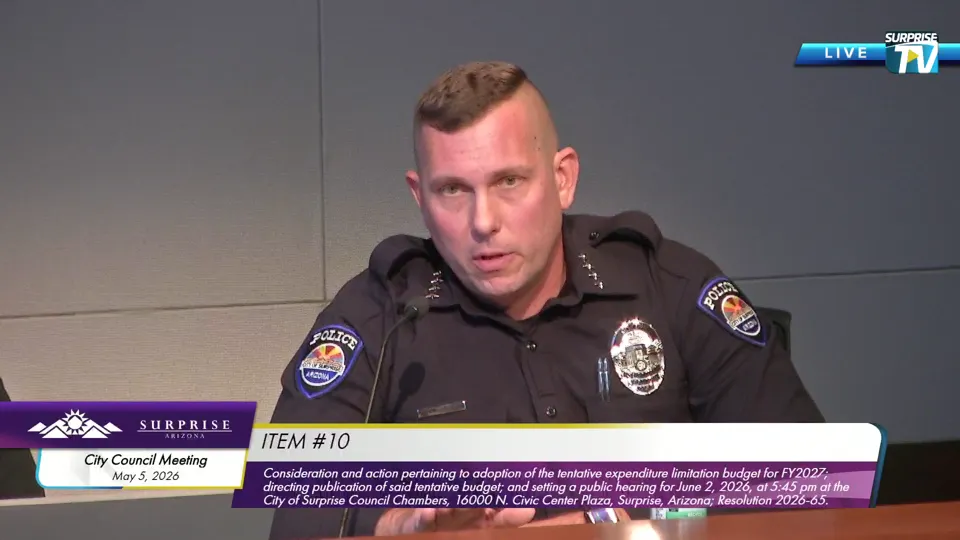
Police Chief Evan Becher told the City Council in May that the department would move school resource officers back to patrol and investigations, and that the schools they leave would be covered by off-duty officers paid through a state grant.
The department had 15 school resource officers at the time, Becher said. For the school year now under way it assigned 10, according to agreements the council approved in June.
"If you want a short answer, yes, we need more police officers," Becher said when a council member asked what it would take to put the officers back.
The change came up May 5, as the council adopted a tentative budget for the fiscal year that began July 1. Finance staff said departments had been asked to stay within their base budgets and that "we need to reduce some service levels and programs." For the Police Department, they said, that meant putting patrol, traffic and investigations first, with "some program changes" to its school resource officers.
Councilmember Chris Judd asked the chief to explain.
Two kinds of officer
Becher said the department was getting 11 new positions in the budget and still had "a wide range of gaps," citing population growth, traffic and a police substation due to open in the north of the city.
The 15 school resource officers were Surprise officers assigned full time to schools from the elementary grades through high school. Under the change, officers in those posts go back to patrol and investigations, and their schools are covered by school safety officers instead.
| School resource officer | School safety officer | |
|---|---|---|
| Who | A Surprise police officer assigned full time to one school | An off-duty officer from Surprise or a neighboring department, working a day off |
| On campus | The same officer, four or five days a week | "Could be a different officer every single day" |
| Paid by | A state School Safety Program grant, up to $171,000 per officer for the school year, which does not cover the full cost of a full-time officer | An Arizona Department of Education grant |
| Cost to the city | The share the grant does not cover | covered by Arizona's School Safety Program |
| This school year | 10 assigned | remaining DUSD schools have SSO officers per the 2026-2027 student handbook |
Source: Police Chief Evan Becher and Councilmember Jack Hastings, City Council, May 5, 2026; the city's agreements with the schools, approved June 16, 2026.
What a school gives up is the same face every day. What the city gains is an officer on the street.
"This is one area where if I make a transition from an officer in the SRO program, I still can get pretty much the same service," Becher said. Asked whether schools would be safe, he said, "The answer is absolutely yes."
Judd said during the discussion that officers were staying in the high schools, and the agreements bear that out: the city's three Dysart high schools are assigned a resource officer this year, as they were last year.
"Sad to see us pulling back"
"I am sad to see us pulling back on SRO," Judd said. He called the officers "a phenomenal tool for community policing" and said restoring them should be a top priority, in the high schools and in any school with eighth graders. He asked whether the answer was simply to hire more police.
It was, the chief said, and growth would make hiring enough of them a challenge. The department had asked for 27 to nearly 30 officers in the fiscal 2027 budget, he said. The budget adds 11 police positions.
Becher said he would rebuild the program "the second we can bring on more SROs."
Councilmember Patrick Duffy said two or three high schools had asked him to keep the officers they have had, some for four years. Becher said the department kept an officer at the same school where it could. Councilmember Jack Hastings, who told the council he is a Dysart Unified School District administrator and has worked with both kinds of officer, described the trade: a resource officer builds a relationship with students, and "it takes an officer off the street."
Councilman Melton asked the chief to confirm that police would still be in schools. "Cops will still be in schools," Becher said.
"That's the reality"
Councilmember Nick Haney tied the decision to money. "Our revenue sources are being cut or attacked," he said, and the city is being asked "to do more with less." Of the choice between an officer in a school and an officer on patrol, he said: "That's the reality, and I appreciate you rebalancing it."
"It's not easy to come to this council, especially with our strategic plan and our focus on school safety, and saying we're going to have to make some changes to it," the mayor told the chief.
Where the officers went
Judd proposed one way to pay for officers: returning part of the city's construction sales tax to the general fund, as it once did. "We're short on cops, we're short on a lot of stuff," he said. Finance staff answered that the tax depends on growth and would be a one-time fix. The council adopted the tentative budget that night as Resolution 2026-65.
Becher said the officers leaving the schools would go to patrol and to investigations, which he described as "in desperate need of help," and that four officers would move into investigations in August.
Ten schools
The council approved the agreements for this school year June 16, on its consent agenda and without discussion. A Police Department presentation in the meeting packet lists 10 assigned officers.
Seven are in the Dysart Unified School District: Valley Vista, Shadow Ridge and Willow Canyon high schools, Sonoran Heights and Cimarron Springs middle schools, and West Point and Kingswood elementary schools. The other three are at charter schools: Paradise Honors High School, Highland Prep and Legacy Traditional School-West Surprise.
The Dysart agreement runs from July 30, 2026, to June 3, 2027, and says officers are assigned "as police department staffing allows." Dysart's governing board approved it July 13, also on its consent agenda and without discussion.
Last school year's agreement, which the Dysart board approved in July 2025, assigned an officer to nine Dysart schools. Three of them are not on this year's list: Ashton Ranch Middle School, Marley Park Elementary and Asante Preparatory Academy. West Point Elementary is new to it. The three high schools kept their officers.
Each school has a state School Safety Program grant of up to $171,000 per officer for the 10-month school year, or $159,000 at Legacy Traditional, the staff reports say. The city bills the school the officer's actual salary and benefits or one-tenth of the grant each month, whichever is less.
The department's size was the subject of a consultant's report to the council in June. Citygate Associates said patrol accounts for 38% of the Police Department's sworn staff, against a recommended 60%, and that the department could need 115 more positions over five years. None of that has been funded beyond the 11 positions in this year's budget.
Becher told the council in June that the department would have more officers on patrol after its next shift change than at any time in his tenure.
More from The Standard: how growth is straining the city's police and fire service.