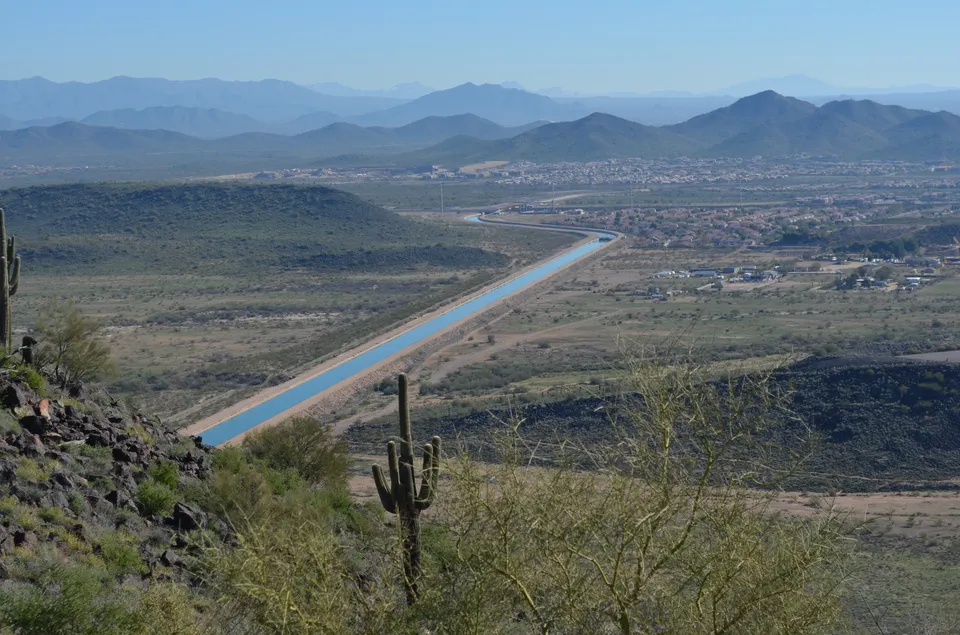
Surprise expects water-bank credits to cover its 2027 CAP cut
Staff put the reduction at about 2,100 acre-feet. A separate conservation proposal could save the water utility about $7 million, but agreements and financial details still need to be settled.
This story was drafted with AI from public records and reviewed by an editor before publication. How we use AI
Surprise expects state water-bank credits to offset a 15% cut in its Central Arizona Project municipal and industrial water supply in 2027, city staff said. Staff put the reduction at about 2,100 acre-feet. They said 2028 would be covered too, though CAP officials describe the bank’s policy as covering only 2027.
The forecast came during the City Council’s November 17 work session, where Michael Boule, the city’s Water Resource Management director, and Amy Peterson, its water resource manager, outlined agreements needed to replace the reduced Colorado River supply and pursue additional conservation. Boule presented the shortage, replacement-credit and savings forecasts.
The city’s existing intergovernmental agreement with the Arizona Water Banking Authority expires in December, Boule said. It must be renewed to provide the mechanism for exchanging credits. He listed the renewal among agreements coming to the council but did not give a date.
Free newsletter
Follow Surprise's water-bank agreements
Free, once a week: the December renewal deadline and proposed conservation agreements, plus the rest of the week's news.
Staff attributed the revised outlook to federal Colorado River operating guidelines for 2027 and 2028. The city presentation says the Department of Interior issued the guidelines on August 21 and identifies a 760,000-acre-foot reduction in Arizona’s supply. Staff said CAP confirmed the resulting 15% reduction for municipal and industrial subcontractors such as Surprise.
A document in CAP’s September 3 board packet also lists a 760,000-acre-foot Arizona reduction for 2027. It says the state-by-state distribution would be confirmed in a forthcoming lower-basin agreement; absent one, the Interior secretary would determine reductions in consultation with those states.
Some figures in the presentation reflect earlier estimates. An October 8 CAP chart, labeled preliminary and included in the city packet, estimates a 14% cut. A city supply scenario lists 1,985 acre-feet in shortage-replacement credits rather than the roughly 2,100 acre-feet staff described aloud.
How credits would replace the supply
The Arizona Water Banking Authority stores excess Colorado River water for use during shortages. Its long-term storage credits account for water previously stored underground.
Staff described Surprise’s normal arrangement as ordering CAP water, storing it in underground recharge facilities, recharging treated wastewater and pumping groundwater to serve customers. The proposed bank credits would replace credits the city otherwise would have generated by storing its CAP supply.
Boule said the authority would cover the mandatory reduction in both 2027 and 2028. The water bank’s shortage policy, as CAP officials and the city’s own slide describe it, covers only 2027. The city’s summary slide says the bank will firm all CAP municipal and industrial reductions “for calendar year 2027.” At an August 20 CAP committee meeting, Natalie Mast, CAP’s water resources and planning manager, said the shortage policy “is only effective for the 2027 calendar year,” while the separate conservation policy runs through the end of 2028. KJZZ reported November 16 that the bank agreed to make utilities whole “for one year.”
Peterson recommended keeping the city in Stage 1 of its drought plan rather than advancing to a higher stage. She expressed confidence that Surprise could absorb the reduction, while emphasizing that the operating guidelines provide certainty for only two years.
Separate conservation plan, potential savings
Beyond the mandatory cut, Surprise could voluntarily leave additional CAP water in Lake Mead under the regional 700-plus conservation plan. The city’s proposal lists contributions of up to 12,081 acre-feet per year, with the water bank expected to assign an equivalent volume of long-term storage credits.
That participation requires two agreements. A system conservation implementation agreement would involve Surprise, the Central Arizona Water Conservation District, which operates CAP, and the Bureau of Reclamation. It would establish how much additional water the city leaves in Lake Mead by reducing its CAP order.
A companion firming agreement would involve the city, the district and the water bank, governing the matching credits.
The October draft firming template describes important limits: credits must be available, conservation receiving monetary compensation does not qualify, and participating utilities bear credit-distribution fees and water-recovery costs. These are draft terms, not confirmation of Surprise’s final obligations.
On November 5, the CAP board unanimously approved templates for both agreements and authorized its general manager to sign them with the participating utilities. The board packet lists Surprise for up to 12,081 acre-feet in both 2027 and 2028, the largest volume of any city on the list. Boule said staff would bring the city’s agreements back to the council individually.
Staff estimated that participation could save the water utility about $7 million by avoiding CAP operations, maintenance and repair costs on water the city would not order. That is a projected reduction in costs, not a payment for conserving water.
A CAP finance draft explains that operating charges apply to water scheduled for delivery and include pumping-energy costs and fixed, non-energy costs. CAP’s board-approved 2027 water delivery rate, which combines those charges, is $326 an acre-foot; its provisional 2028 rate is $340. Staff did not say which volumes, rates or years produce the $7 million figure.
Free newsletter
Follow Surprise's water-bank agreements
Free, once a week: the December renewal deadline and proposed conservation agreements, plus the rest of the week's news.