Understanding Surprise's water supply in an uncertain future
Every drop from a city tap is groundwater. The city puts back Colorado River water and treated wastewater to balance what it pumps, and banks the difference with the state. Here is how the whole system fits together, and where the Colorado River cuts and future growth put pressure on it.
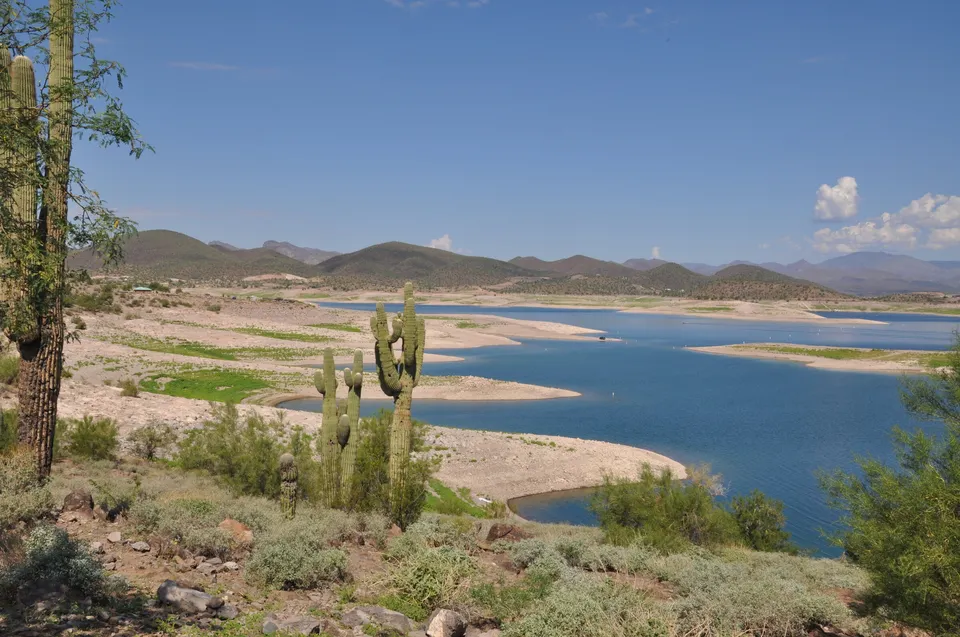
Lake Pleasant, north of Surprise, is where the Central Arizona Project stores Colorado River water. Its level rises and falls through the year; this is a low point in September 2013. Photo: Cathixx / Wikimedia Commons, CC BY-SA 3.0.
This story was drafted with AI from public records and reviewed by an editor before publication. How we use AI
Most Surprise residents know two things about their water. It comes out of the ground, and somewhere in the picture is the Colorado River. How the pieces connect is harder to see.
The short version: the city pumps groundwater for its customers, then puts water back underground to make up for it. It uses two sources to do that, Colorado River water and the city's own treated wastewater. The state keeps count of what goes back in, and the city can draw on that balance in a drought.
Starting in January, the river side of that system gets smaller. This series explains each part, and what the cuts mean for the city and its growth.
The tap: all groundwater
Every gallon from a City of Surprise tap is pumped from wells. "Surprise is a city that delivers all groundwater to our customers for drinking water, and then we take all of our wastewater and our CAP supply and we recharge that to offset what we're pulling out of the ground," Amy Peterson, the city's water resource manager, told the City Council in April.
Not every address gets city water. EPCOR, a private utility, serves much of the east side. Liberty Utilities serves much of the far north, and El Mirage serves the original townsite.
The savings account: long-term storage credits
When the city stores water underground, the state credits it with water it can pump back later. One credit is one acre-foot, about 326,000 gallons. The city's policy is to keep 15 years of demand in the bank, and staff told the council in April the balance runs between 15 and 16 years.
The city treats about 12 million gallons of sewage a day and sends most of it back underground through recharge wells and basins. Last year the treated wastewater it recharged equaled 98% of the groundwater it pumped, according to the city's budget. The city also treats sewage from many homes whose drinking water comes from EPCOR and Liberty, so it recharges water it never pumped.
Free newsletter
Follow this story
Free, once a week: what happens next on stories like this one, and the rest of the week's Surprise news.
Part 2: What happens to Surprise's wastewater, coming soon, follows that water from the drain to the aquifer, and looks at the city's plants as they fill up.
The river: Colorado River water and the coming cuts
Surprise holds rights to 14,181 acre-feet a year of Colorado River water through the Central Arizona Project. None of it goes to a tap. The city sends it to recharge basins or to farms that use it instead of pumping their wells, and earns credits either way. Arizona's share of the river drops by 760,000 acre-feet a year starting in January. For 2027 the state water bank plans to cover cities' losses, and Surprise is listed to leave up to 12,081 acre-feet in Lake Mead in exchange for the bank's credits.
Part 3: Surprise pumps its tap water from the ground. The Colorado River cuts reach it there., coming soon, explains what changes next year, what the city pays for its river water, and the larger risk after 2028.
The future: room to grow
To serve new homes, the city must show the state a 100-year water supply, and its plan looks 10 years ahead at a time. In April about 10,578 acre-feet a year of its water budget was not yet spoken for. Staff said current customers and homes already in the pipeline are covered under every shortage scenario they presented. The city's development fee report says it "will need to dramatically expand its water resource portfolio" to serve growth beyond that.
Part 4: Does Surprise have the water to keep growing?, coming soon, looks at what the city has committed, what it would cost to add more, and what developers are asked to bring.
Key terms
Acre-foot: about 326,000 gallons, enough to cover an acre of land a foot deep.
CAP: the Central Arizona Project, the canal that carries Colorado River water to the Phoenix and Tucson areas.
Recharge: putting water back into the aquifer through basins or wells.
Long-term storage credit: the state's record of water stored underground that its owner can pump back later.
Assured water supply: the state requirement that a provider show 100 years of water before new homes can be sold.
Effluent: treated wastewater.
Free newsletter
Follow this story
Free, once a week: what happens next on stories like this one, and the rest of the week's Surprise news.