Surprise's water savings account: what long-term storage credits are, and how the state keeps count
Every gallon from a city tap is pumped from the ground. The city balances that by storing Colorado River water and treated wastewater underground, earning state credits it can draw on in a drought. Here is how the credits are earned, checked and spent.
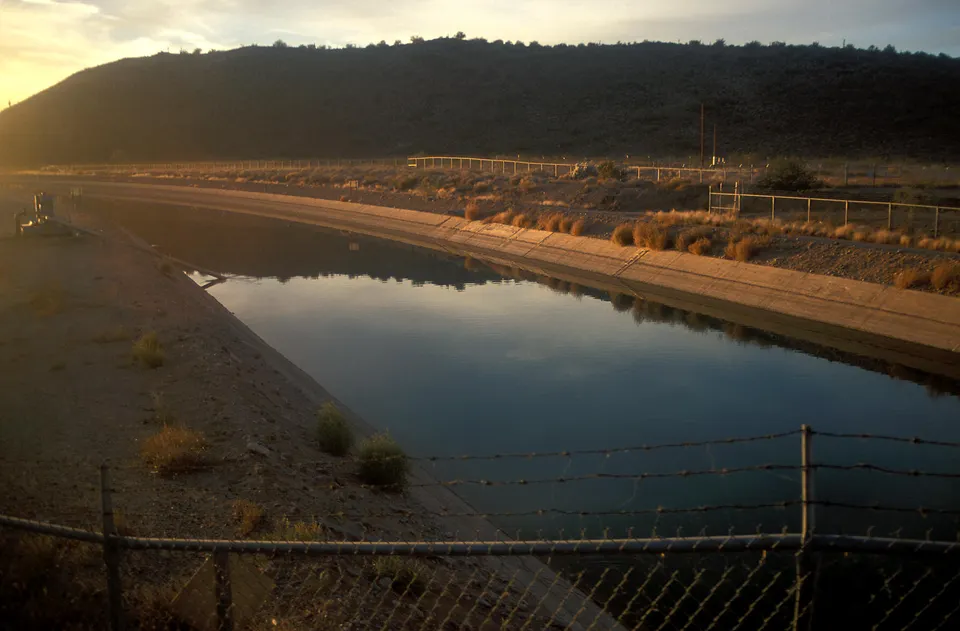
The Central Arizona Project canal in north Phoenix. Photo: Dexter Perkins / Wikimedia Commons, CC0.
This story was drafted with AI from public records and reviewed by an editor before publication. How we use AI
This is the first of four stories on where Surprise's water comes from and where it goes. The others cover the city's wastewater, the Colorado River cuts that begin in January, and whether there is water for the homes still to be built. Read the overview of the series.
Surprise does not pipe river water to homes. Every gallon that comes out of a city tap is groundwater, pumped from wells.
"Surprise is a city that delivers all groundwater to our customers for drinking water, and then we take all of our wastewater and our CAP supply and we recharge that to offset what we're pulling out of the ground," Amy Peterson, the city's water resource manager, told the City Council at an April 7 work session.
What the city gets for putting water back is a long-term storage credit. The credits are the city's reserve for a drought, for cuts to its Colorado River water, and for growth. City staff call it a savings account.
What a credit is
A long-term storage credit is a state record that someone stored water underground and is entitled to pump it back out later. One credit is one acre-foot, about 326,000 gallons.
Arizona created the system so that cities could store water they cannot use right away. Water that "cannot reasonably be used directly," such as Colorado River water delivered by the Central Arizona Project or treated wastewater, can earn credits when it is stored, according to state law and a 2023 summary by the law firm Snell & Wilmer. The Arizona Department of Water Resources keeps an account for each credit holder. Credits do not expire and can be sold.
Surprise earns credits from two sources.
The first is its Colorado River water. The city holds a CAP subcontract for 14,181 acre-feet a year, according to CAP. CAP's delivery records show the city has not sent any of it to a treatment plant. In 2024 and 2025 all of it went to the Hieroglyphic Mountains Recharge Project, basins owned by CAP where the water soaks into the ground. In 2021 through 2023, and for most of this year, it went to farm irrigation districts. The farms used the city's river water in place of pumping their own wells, and the city earned a credit for the groundwater they left in the ground.
The second is its wastewater. The city treats sewage at its own plants and sends nearly all of the cleaned water underground through wells and basins. That is the subject of the second story in this series.
Not every gallon counts the same
The state does not credit every acre-foot stored.
For river water stored in a basin, the department credits 95% of what was stored, according to state law. The other 5% is the "cut to the aquifer," water that stays underground for good.
Treated wastewater stored at a built facility such as a recharge well or basin earns 100%.
At a farm, the storer earns credit only for the share of the water it can show replaced groundwater pumping "gallon-for-gallon," according to a University of Arizona paper on the program by Sharon Megdal and Taylor Shipman. If it cannot prove the full amount, only the proven share is credited, state law says.
How the credits are checked
Storing water for credit takes three state permits: one for the facility where the water goes underground, one for the person storing it, and one for each well used to pump it back out, according to the Snell & Wilmer summary and the Legislature's description of the program.
Every permit holder must file an annual report with the department, even in a year when nothing was stored or recovered. The department uses the reports to compile how much water went into each facility, how much was stored under each permit and how much was pumped back out, and updates each holder's account from them.
Free newsletter
Follow this story
Free, once a week: what happens next on stories like this one, and the rest of the week's Surprise news.
Some of the numbers can be checked against another public record. CAP publishes monthly reports of how much water it delivered to each recharge facility and farm district, and for whom. Those reports show Surprise's deliveries each year since 2021: 10,249 acre-feet in 2021, 7,000 in each of 2022 and 2023, 10,249 in each of 2024 and 2025, and 9,910 through August of this year.
Getting the water back
A credit is used by pumping. The city pumps groundwater from its own wells, and the state counts that water as recovered rather than as new groundwater.
Where the pumping happens matters. If a city well is within a mile of the place the water was stored, "the state says you're not pumping groundwater, you're pumping what you recharged," a city water resources staff member told the council in April. In January the city asked the state to widen that radius at three recharge sites, using modeling to show its years of recharge have raised the aquifer farther out.
The city received permits for 27 recovery wells in 2025, The Arizona Republic reported.
The farm deliveries carry a catch. A farm that takes a city's river water does not give up its own right to pump. "Should affordable CAP water no longer be available, the agricultural entity has the right to return to groundwater use," Megdal and Shipman wrote. The city keeps the credits it already earned. The groundwater those credits stand for stays in an aquifer others can draw from too.
How big is the balance
The city's policy is to hold credits equal to 15 years of its net demand. The development fee report the council most recently amended June 2 quotes the city's water acquisition policy: "the City will maintain a minimum balance … equal to 15 years or 15 times the City's service area net demand."
City staff told the council in April the balance moves between about 15 and 16 years. Each year the city banks more water, but its demand also grows, so the number of years shifts. Councilmember Chris Judd asked why the figure had dropped from the 17 or 18 years he remembered. When he summed up that the supply had not gone down, only the demand on it, a staff member said, "That's exactly right."
The state last published Surprise's balance at about 75,662 acre-feet, as of the end of 2019. The city has also moved credits out. A 2017 draft agreement posted by the Arizona Water Banking Authority would have the bank buy about 9,082 acre-feet of credits from Surprise for $2 million. El Mirage, which serves Surprise's original townsite, received about 6,000 credits from Surprise last year, according to a summary of an El Mirage council meeting.
Drawing on the account in a drought
Credits are the first thing the city points to when asked about shortages. If cuts to the Colorado River squeeze growth, staff told the council in April, "we could begin to use our savings account for the 15 years with the groundwater that we've saved up."
The state has its own account, held by the Arizona Water Banking Authority, filled over decades with river water the state stored underground. It plans to use those credits to cover cities' share of the Colorado River cut in 2027. For Surprise it may do more. CAP's packet for its Oct. 1 board meeting lists the city for up to 12,081 acre-feet to be left in Lake Mead next year, in exchange for a matching volume of the bank's credits. The third story in this series explains that trade.
Credits also have a price. The city's development fee report lists what it estimates new water costs: $500 an acre-foot to lease credits from a tribe, $850 through the state's replenishment district and $2,700 for a new renewable supply. Peoria agreed in September to pay $104 million for about 176,000 acre-feet of stored credits, KTAR reported, about $590 an acre-foot.
The city is rewriting its drought preparedness plan, which state rules require every five years. Its last version was tied to the old Colorado River shortage tiers, staff said, and staff said in April that a draft would come to the council in December.
Free newsletter
Follow this story
Free, once a week: what happens next on stories like this one, and the rest of the week's Surprise news.